
Entry Duty Calculator Changelog
This page is the changelog for the entry duty calculator, in reverse chronological order. The most recent update is highlighted at the top, followed by the history grouped by month — and within each month by area — reaching back to the calculator's first release in August 2025. The entry duty calculator is in Beta.
September 2026
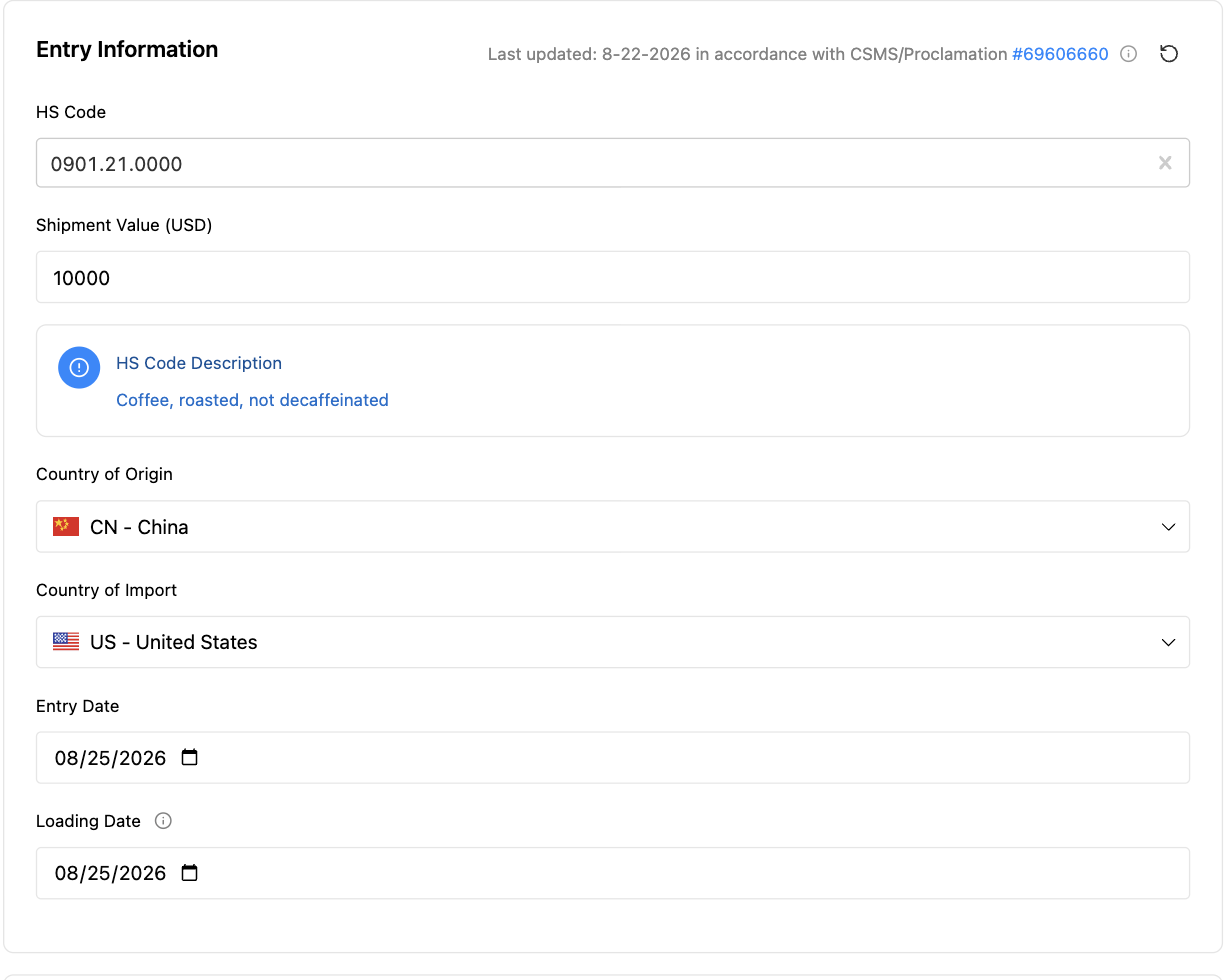
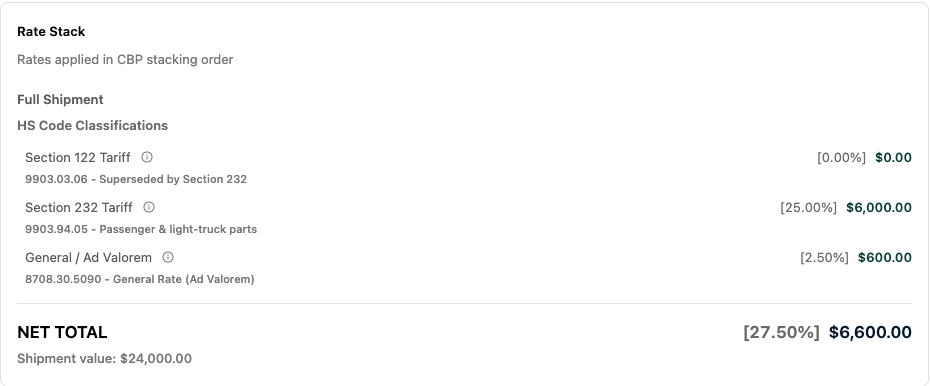
A redesigned entry form for the entry duty calculator — fewer inputs on screen, clearer labels, a rate stack that follows CBP stacking order, and deeper Section 232 coverage.
Entry-form UX: layout, inputs, toggles, and validation
- The form now shows only the fields and programs that apply to your entry. Options that cannot apply for your HS code and country of origin — a civil aircraft list, a USMCA claim — stay off the screen.
- Quantity appears only when the tariff code requires it.
- Loading Date now sits in the main form rather than in a separate section.
- Clearing the HS code clears the form, and the materials list resets with it, so you start clean.
Tariff rate priority, sort order, and CBP ACE compliance
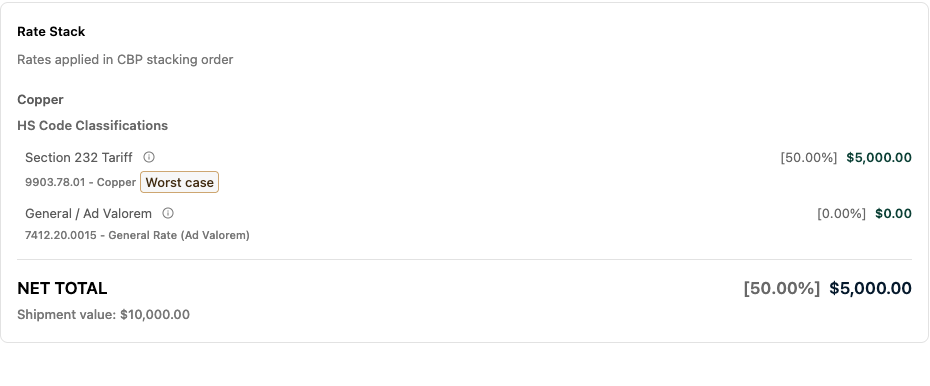
- The result is now a rate stack: every rate that applies, listed in the order Customs applies them, ending in a single net total.
Chapter 99 display names and exclusion code visibility
- Exclusions are now checkboxes with plain-English names, each carrying a definition on hover instead of a bare code.
- Section 232 timber exemptions now sit alongside the other exclusions.
US Section 232 — steel and aluminum (including derivatives)
- Steel and aluminum now default to the worst case until you declare where the metal came from, rather than pricing a more favorable origin.
US Section 232 — automotive and auto parts (including USMCA interaction)
- Certified-parts claims are now their own opt-in rather than bundled in with on-list auto parts.
- Medium and heavy-duty vehicles are now handled separately from passenger vehicles.
August 2026
Two new trade programs and a large round of Section 232 accuracy work across metals, vehicles and pharmaceuticals.
Country and program coverage
- Added the Section 338 Canada duties effective August 22, 2026, per CBP bulletin CSMS #69606660.
- Added the Section 201 safeguard for quartz surface products, including a quota-tier input so you can price in-quota and out-of-quota entries.
- Added PGA flags and units of quantity to the calculation, so partner-agency requirements surface alongside the duty.
- Successor HS codes now inherit the program lists of the codes they replace, so a re-numbered code keeps its Section 232 and Section 301 treatment.
US Section 232 — steel and aluminum (including derivatives)
- The materials list no longer caps the worst case it shows, so an undeclared metal origin is priced at the full conservative rate rather than a capped one.
- The result now shows, and keeps, the Section 232 content the estimate is based on, so you can see which declared material drove the penalty.
- The under-15% metals exemption is now a claim you make rather than an automatic assumption.
- Exemption 9903.82.03 is now an election, and the worst-case badge no longer displays inverted.
- Metals inputs now appear only for HS headings that carry a metals program.
- Section 232 metals falling outside a program's effective window are now reported as out-of-window rather than silently applied.
- Section 232 timber is now limited to the listed softwood codes.
- A reduced Section 232 rate for UK steel now requires a producer attestation before it applies.
US Section 232 — automotive and auto parts (including USMCA interaction)
- Medium and heavy-duty vehicle exclusions are now gated on an election, so a whole-vehicle exclusion applies only when you claim it.
- A chassis is now offered every Section 232 program it is listed on, rather than only the first match.
- The two clauses of exclusion 9903.94.06 are now handled separately, and a claim cascades to medium and heavy-duty vehicle parts first.
- Corrected Chapter 99 stacking for UK and rest-of-world Section 232 auto entries.
- The note-38(l) medium and heavy-duty parts offer is now date-gated, and exclusion 9903.94.31 now enforces UK origin.
- Claiming an exit from a Section 232 vehicle program now toggles the related programs and keeps the exclusion offered.
- When no automotive class is elected, the note-33(g) penalty now applies rather than being skipped.
US Section 232 — pharmaceuticals and semiconductors
- Pharmaceutical use is no longer inferred from Annex IV membership — declare it explicitly where the section appears.
- Pharmaceutical exclusions 9903.04.60 through .69 are now elections you make rather than automatic claims.
- Added the note-39 semiconductor carve-outs as claimable exclusions.
- After you claim within a pharmaceutical or semiconductor family, sibling exclusion chips are hidden rather than left offered.
Chapter 99 display names and exclusion code visibility
- Chapter 99 codes now carry both a short and a long display name, so a code reads the same way across the form and the result.
- Added the civil aircraft exclusion codes as offers you can claim.
- Corrected the country-specific Section 301 Forced Labor exclusion reported under a USMCA claim.
- Claim-gated the Brazil Section 301 particular-articles exclusion 9903.05.04, and relieved Brazil Section 301 pharmaceutical entries through 9903.05.06.
- Section 301 China entries now resolve their note-31 heading directly, correcting the code shown.
July 2026
Brazil Section 301 and Section 301 Forced Labor coverage, extensive Section 232 vehicle and metals corrections, and clearer exclusion offers.
Country and program coverage
- Added the Brazil Section 301 tariff 9903.05.01, with its exclusions, including a user-claimable pharmaceutical-use exclusion.
- Added Section 301 Forced Labor tariffs covering 60 economies, with the Note 52(b) through 52(k) exclusions and Norway coverage.
- Forced Labor Section 301 top-ups now calculate against the applicable column-1 rate, so an FTA claim is reflected in the top-up.
- Section 301 exclusion 9903.88.69 is now offered only when the HS code appears on the USTR product list.
US Section 232 — automotive and auto parts (including USMCA interaction)
- Certified-parts treatment is now decoupled from the on-list auto parts offer, and the medium and heavy-duty 25-year exclusion is offered where it applies, including for buses.
- The medium and heavy-duty vehicle disclaimer for 9903.74.11 now renders alongside the 9903.94.05 auto parts result rather than replacing it.
- Reconciled medium and heavy-duty vehicle and parts membership against U.S. note 38.
- Claiming on-list exclusion 9903.94.06 now cascades the Section 232 program order correctly.
- Corrected the medium and heavy-duty parts code 9903.94.06 and the default bus code 9903.74.02.
US Section 232 — steel, aluminum and pharmaceuticals
- Corrected the Section 232 Annex I aluminum HTS list and the weight-threshold rules, and grandfathered affected UK and Netherlands steel entries.
- Added the note 16(k) parts relief, a Russia-aluminum country-of-origin trigger, and date-aware handling of the Russia NTR suspension.
- Aligned Section 232 pharmaceuticals with final CBP guidance per bulletin CSMS #69395344.
- Added a curated resolver for HS codes that appear on more than one metals list, so the governing metal is chosen consistently.
Chapter 99 display names and exclusion code visibility
- Exclusions already applied to your entry are no longer offered again.
- Chapter 99 codes sourced from a data provider now display their code rather than appearing blank.
- Donation exclusions 9903.01.21 and 9903.01.30 are now offered only while the underlying IEEPA program is live.
- Added the Annex III importer-agreement option for 9903.04.61.
Entry-form UX: layout, inputs, toggles, and validation
- Preferential program names are now spelled out in the program dropdown instead of appearing as SPI codes alone.
- Rates now show when they were last updated, with the Customs bulletin number behind them, so you can see what the calculator has taken in.
- The General and MFN base row now renders last in the results pane, below the additional duties that stack on it.
June 2026
UK CBAM and two new destinations, the June 8 Section 232 amendment, and USMCA content splitting for vehicles.
Country and program coverage
- Added UK CBAM for Great Britain destinations.
- Onboarded Japan and South Korea, each with a validated tariff configuration.
- Corrected the reciprocal tariff start date for Brunei, Japan and Malaysia from April 8 to April 9.
- Reciprocal tariff corrections are now scoped by Chapter 99 heading.
- EU autonomous suspensions are now treated as conditional relief rather than the headline rate.
US Section 232 — steel and aluminum (including derivatives)
- Implemented the June 8, 2026 Section 232 amendment and the corrections in CBP bulletin CSMS #68855869.
- The Annex III metals floor now refills to the 15% cap under a USMCA claim.
- Exclusion 9903.82.01 is now emitted for entries with 0% subject-metal content.
US Section 232 — automotive and auto parts (including USMCA interaction)
- For USMCA-eligible passenger vehicles and medium- and heavy-duty vehicles, the Section 232 25% auto tariff now applies only to non-U.S. content — you enter the approved U.S. content value and the calculator works out the non-U.S. portion.
- Lithium-ion batteries imported from Taiwan are now treated as Section 232 automotive parts, correcting their duty calculation.
US Section 232 — pharmaceuticals
- The calculator now applies Section 232 duties to pharmaceutical imports, classifying them under the correct Chapter 99 heading and stacking the additional duty.
Civil aircraft exemption (9903.02.76 and related codes)
- Corrected the Section 122 exclusion code reported when you claim the Civil Aircraft Parts exemption.
- The General and MFN base rate is now preserved when a civil aircraft exemption removes a conditional reciprocal tariff.
HS code handling: validation, prefix matching, and HS98
- Added an HS code validity gate, with messaging when a code is expired or not yet effective for your entry date.
Tariff flags (ADD/CVD/Quota) and special handling
- The IEEPA Suspended position is now honored for conditional reciprocal tariffs.
- Corrected the Additional Potential Codes tooltip text for 9903.94.07 and 9903.76.04.
May 2026
Entry-form UX: layout, inputs, toggles, and validation
- Country of Origin dropdown now shows the full ISO-3166 country list.
April 2026
US Section 232 — steel and aluminum (including derivatives)
- Implemented the April 2026 Section 232 Annex revision, overhauling how metals tariffs stack.
- Annex 2026 calculations now auto-add aluminum, copper, and Annex I-B derivative materials so you do not have to enter them manually.
- Added HS 7602 and 7603 (aluminum waste/scrap and powders) to the Section 232 aluminum rules.
- Aluminum entries with unknown processing country are now treated as Russia-origin for Annex 2026, producing the conservative high duty.
- Annex 2026 duties on US-processed aluminum are now treated as material penalties rather than ignored.
- Section 232 UK and US reduced rates now check the total product threshold before applying.
- Fixed a false-positive less-than-15% metal exemption and stopped the calculator from auto-adding Russia aluminum where it should not for Annex 2026.
- Several Annex 2026 fixes covering material auto-addition, exclusion handling, and rate selection.
- Weight-threshold exempt entries (less than 15% metal) no longer incorrectly suppress the Section 122 surcharge.
- Motorcycle exclusion 9903.82.13 now correctly zeroes the 200% Russia aluminum penalty.
- Fixed a Section 232 steel rate that was displaying 50% for entries dated before June 4, 2025; the historical rate is now applied.
- When an HS code falls under a multi-metal Annex 2026 prefix, the calculator now preserves all relevant metals rather than dropping some.
- Added support for exclusion code 9903.82.01 for Section 232 entries with no metal content.
US Section 232 — automotive and auto parts (including USMCA interaction)
- Calculator now outputs the Section 232 Auto exclusion code for non-automotive products that fall in the same HS range.
- Calculator synthesizes the Section 232 Auto exclusion code on entries used for non-automotive purposes so you see it as a claimable option.
- Restored Section 232 Auto Parts duties on HS codes that fall outside the narrow automotive list when used in autos.
- When Section 232 Auto applies, the calculator now suppresses Annex 2026 metals duties on those same auto parts to avoid double duty.
- When the motorcycle exemption fully suppresses Section 232, the Section 122 10% surcharge is now still applied.
- The automotive Section 232 HS-code fallback now only fires when the entry date is within the Section 232 Auto effective dates.
US Section 232 — wood, timber, and furniture
- Narrowed the Section 232 timber HS prefix from all of 9403 to wooden-only subheadings, preventing over-application to non-wood furniture.
IEEPA reciprocal and country-specific tariffs
- Corrected the EU reciprocal tariff rate for the August 7-17, 2025 window.
- Corrected the China and Hong Kong reciprocal tariff start date to April 9, 2025.
- Corrected the China reciprocal tariff May 13, 2025 boundary so entries on either side use the right rate.
USMCA, Mexico, and Canada coverage
- Added Mexico and Canada tariff strategies, allowing the calculator to compute duties when the destination is MX or CA.
EU and customs union destination support
- Expanded the calculator to support 122 countries via a country-strategy pattern.
- Added a full EU tariff stacking strategy so the calculator can compute duties for EU member-state destinations using the common external tariff.
Section 301, Section 122, and other US trade remedies
- Expired Section 301 Chapter 99 code 9903.91.04 and added the display name for 9903.91.06.
- Russia NTR-suspension Chapter 99 code is now displayed for Column 2 rates.
Chapter 99 display names and exclusion code visibility
- Chapter 99 display names regenerated from the canonical USITC spreadsheet.
- Chapter 99 header descriptions updated to Altana canonical names.
Entry-form UX: layout, inputs, toggles, and validation
- IEEPA toggle is now shown but disabled when it is not relevant for the entry.
- Calculator now warns you when an entered HS code has validity concerns.
HS code handling: validation, prefix matching, and HS98
- Calculator now supports historical HS codes by filtering on entry date.
Partner branding
- Added a partner brand configuration to the entry duty calculator.
Tariff rate priority, sort order, and CBP ACE compliance
- Calculator now merges regulatory effective dates into period boundaries so rate changes line up with effective dates.
Errors, edge cases, and reliability
- Calculator API now returns the correct HTTP status code on error paths so embedded callers can react properly.
March 2026
US Section 232 — steel and aluminum (including derivatives)
- Russia aluminum line items that the calculator adds on a full-shipment basis are now flagged so you can tell which lines were auto-added.
- Section 122 surcharge now applies when the Section 232 steel rate is 0% for US-origin material.
- 9903.81.92 steel US melt/pour code now displays for same-country US country-of-origin imports.
US Section 232 — automotive and auto parts (including USMCA interaction)
- Section 232 penalty duties now surface their possible exclusion codes so you can see what to claim.
US Section 232 — semiconductors
- Fixed three output issues affecting Section 232 Semiconductor calculations.
- When you answer No to the Section 232 Semiconductor toggle, the calculator now emits exclusion code 9903.79.02.
US Section 232 — wood, timber, and furniture
- Section 232 wood furniture penalty is now restricted to four specific HS10 codes rather than broader prefixes.
- Removed HS prefix 4409 from the Section 232 timber program so prepared wood is not over-tariffed.
- Added country-specific Chapter 99 codes for Section 232 on kitchen cabinets and vanities.
IEEPA reciprocal and country-specific tariffs
- Calculator now scales correctly under high-volume use.
- Updated changed tariff codes for Brazil IEEPA.
- When both flat and conditional reciprocal tariffs exist for an HS code, the calculator now filters out the flat variant.
- Reciprocal on-water exemption now respects an entry deadline.
- Corrected the reciprocal on-water exemption (9903.01.28) entry deadline from August 7 to June 17.
- Added a retroactive correction so EU reciprocal tariffs use the IEEPA format for the affected window.
USMCA, Mexico, and Canada coverage
- Date-gated the USMCA IEEPA exclusions for Mexico and Canada so they only fire within the correct window.
- Calculator now injects the correct reciprocal exclusion code for Mexico and Canada USMCA entries.
- Free trade agreement claims are now preserved through Nexus preprocessing so they are honored downstream.
EU and customs union destination support
- When an HS code lookup misses for a customs-union member, the calculator now falls back to the union-level rate.
- Added Liechtenstein and Monaco to the supported destinations dropdown via customs-union aliasing.
Civil aircraft exemption (9903.02.76 and related codes)
- Added the correct Chapter 99 tariff code for the Switzerland civil aircraft exclusion.
- EU derivative steel penalties now output civil aircraft exemption 9903.02.76 when applicable.
Section 301, Section 122, and other US trade remedies
- Section 301 exclusions now surface as user-declarable Additional Potential Codes so you can claim them.
- Added Section 122 to the CBP HTS sort order so it sorts correctly on the printable summary.
Annex II and reciprocal exclusion handling
- Prevented false-positive deduplication when injecting reciprocal exclusion codes.
Chapter 99 display names and exclusion code visibility
- Added USITC display-name mapping so Chapter 99 codes show their official short names.
Entry-form UX: layout, inputs, toggles, and validation
- Date inputs are now validated and invalid dates are handled gracefully.
HS code handling: validation, prefix matching, and HS98
- HS codes starting with 98 (Chapter 98) are now filtered out of the calculator.
Tariff flags (ADD/CVD/Quota) and special handling
- Calculator now synthesizes the MHDVP penalty when it is missing from the underlying data source.
February 2026
US Section 232 — steel and aluminum (including derivatives)
- Fixed Column 2 base-rate selection and corrected Section 232 aluminum penalty calculations.
- For GB origin, the generic Section 232 aluminum rate now applies before any UK-specific penalty rate.
- India steel imports past the in-transit window now use the correct Section 232 exclusion code 9903.01.87.
- 200% Russia aluminum penalty no longer applies when aluminum composition is 0%.
- When a material composition is not provided, the calculator now defaults to the worst-case 100% composition rather than skipping the penalty.
US Section 232 — automotive and auto parts (including USMCA interaction)
- When Section 232 Auto Parts suppresses IEEPA on a Brazil entry, the calculator now correctly outputs the 9903.01.83 IEEPA Brazil exclusion code.
- Suppressed the automotive exclusion code 9903.94.06 when Section 232 Semiconductor is active.
- Fixed GB Section 232 Auto Parts stacking issues that produced wrong totals.
- Calculator now infers whether a product is for automotive use from its HS code when you do not select it.
- Section 232 Auto and Medium-and-Heavy-Duty Vehicle Parts (MHDVP) penalties are now filtered by automotive-use classification.
- When MHDVP applies, it now takes precedence over Section 232 Aluminum penalties.
- When the Section 232 Auto or MHDVP override is active, all aluminum penalties are suppressed.
- Fixed post-IEEPA termination filtering and corrected automotive inference for laptop HS codes.
US Section 232 — semiconductors
- Improved Section 232 Semiconductor HS6 inference and corrected the exclusion code shown.
US Section 232 — wood, timber, and furniture
- Fixed an issue where timber Section 232 duties were appearing twice on the same entry.
- Corrected the HS codes and rates used for timber Section 232.
- Reclassified wood Section 232 duties as whole-good duties and switched the materials input to a dropdown for these entries.
- Country-specific Section 232 wood furniture tariff codes are now auto-applied based on country of origin.
- Added kitchen cabinets, vanities, and country-specific wood penalties to the recognized wood-penalty list.
IEEPA reciprocal and country-specific tariffs
- Fixed reciprocal tariff date-based formula and the zeroing of base rates when reciprocal applies.
- Fixed Japan reciprocal bug-window handling for base-rate zeroing and the in-transit exemption.
- Corrected IEEPA naming for EU, Japan, and Korea reciprocal tariffs.
- IEEPA Brazil exclusion is now emitted on its exact effective date rather than the day after.
- Handled the IEEPA India (9903.01.84) termination effective February 7, 2026.
- Fixed several IEEPA transit-exemption issues affecting China tariff codes.
- Closed reciprocal tariff coverage gaps across all countries and improved civil-aircraft exemption handling alongside it.
- Reciprocal tariff codes are no longer emitted on entries dated before the program's effective date.
- Prevented duplicate reciprocal exclusion codes from appearing in the output.
- Added 129 missing Executive Order codes to the Brazil Annex I(a) product list under 9903.01.81.
USMCA, Mexico, and Canada coverage
- Fixed several USMCA Canada tariff calculation issues.
- Canadian energy duties now use the government's official list, and softwood lumber uses the correct rate.
Civil aircraft exemption (9903.02.76 and related codes)
- Implemented the civil aircraft exemption in the entry duty calculator.
- Added an effective-date check for the GB civil aircraft exemption (9903.96.01).
- EU civil aircraft exemption now returns the correct 9903.02.76 code for copper.
- Civil-aircraft-use is now only auto-inferred for Chapter 88 HS codes, eliminating false positives elsewhere.
- Automotive use and civil aircraft use auto-inference are now mutually exclusive.
Section 301, Section 122, and other US trade remedies
- Fixed Section 301 composite-rate double counting in the output.
- Section 301 now uses the AddDuty notes rate, preventing duplicate Section 301 lines.
- Added Section 122 (import surcharge) support to the calculator.
- Added missing Section 122 exclusion codes to the Additional Potential Codes UI.
Annex II and reciprocal exclusion handling
- Added missing Section 232 exclusion codes for copper.
- Fixed Annex II exclusion handling for copper HTS 7419.80.5050 after Section 232 applies.
- Corrected country-of-origin restrictions and date boundaries on Annex II exemptions.
- Preserved leading zeros on HS codes when emitting Annex II exclusions.
- Closed Annex II exclusion gaps across all five tariff programs.
- Corrected Annex II exclusion handling and migrated each program's product list to YAML for auditability.
- Country-specific reciprocal exclusions are no longer applied to Section 232 material lines.
Chapter 99 display names and exclusion code visibility
- Added broader tariff exemption and exclusion code support to the calculator.
- Informational material exclusions are now user-declarable rather than auto-applied.
Entry-form UX: layout, inputs, toggles, and validation
- Renamed the "Unit Count" field to "Quantity".
- Moved the Unit Count field to the main form and added a dynamic unit-type label.
- Rearranged the entry form layout and added exclusion-codes UI.
- Material composition inputs now accept leading zeros.
- Renamed "Special Program" to "Preferential Tariff Programs" in the UI.
- Material composition entries now accept 0% values.
- Material composition fields now reset when the input is cleared.
- Added an IEEPA tariff zeroing toggle to the entry duty calculator.
- Expanded DR-CAFTA textile exclusion handling and now require an explicit FTA claim from you.
Per-unit, compound, and ad-valorem-equivalent duty handling
- Fixed compound duty rate calculations for rates that omit an explicit calculation method.
- Added an ad-valorem-equivalent rate to the compound duty display.
- Stale duty results are now cleared when you switch to a per-unit HS code.
- Per-unit duty rates now preserve full numeric precision instead of rounding.
HS code handling: validation, prefix matching, and HS98
- Increased the HS-code search debounce to reduce API load and flicker.
- Calculator now blocks duty calculation for HS10 codes that require a secondary HS10.
Materials, composition, and material penalty handling
- Materials with undefined composition are now filtered out at all API call sites.
Comparison grid, deep linking, and presentation
- Fixed mobile text cutoff in the duty calculator card title.
- Synced the comparison grid with the main calculator output and fixed a tooltip.
Tariff flags (ADD/CVD/Quota) and special handling
- Fixed an Australia FTA tariff stacking issue.
Errors, edge cases, and reliability
- Duty totals are now displayed based on data presence rather than internal status, so partial results no longer flash empty.
January 2026
US Section 232 — steel and aluminum (including derivatives)
- Added Section 232 steel derivative penalties to the calculator's recognized duty list.
- Fixed multiple Section 232 steel and aluminum stacking issues that produced incorrect totals.
- Fixed UK steel penalty incorrectly applying to all non-US steel; it now applies only when the steel is UK-origin.
- Corrected the Chapter 99 code used for the US steel melt-and-pour exemption.
US Section 232 — automotive and auto parts (including USMCA interaction)
- Goods classified as subject to Section 232 Auto are now correctly assessed even when USMCA is claimed, for entries on or after October 17, 2025.
- IEEPA duties are no longer applied when the Section 232 Auto override is active.
- Calculator no longer auto-adds materials when the Section 232 Auto override is active.
US Section 232 — semiconductors
- Implemented Section 232 Semiconductor and Logic IC tariffs in the calculator.
- Section 232 Semiconductor entries now correctly suppress Russia aluminum penalties.
IEEPA reciprocal and country-specific tariffs
- Added a loading-date input to support IEEPA in-transit exemptions and two key hard-coded loading-date rules.
- Fixed the reciprocal in-transit exemption for countries like Cambodia where it was not firing.
USMCA, Mexico, and Canada coverage
- USMCA calculations now filter out transship penalties; also corrected several subtle issues in non-USMCA cases.
Annex II and reciprocal exclusion handling
- Reciprocal exclusion now uses Annex II code 9903.01.32 for HTS 8473.30.5100.
HS code handling: validation, prefix matching, and HS98
- Section 232 penalties now apply via HS code prefix matching, not exact match.
- Replaced a confusing HS code error message with clearer guidance.
Partner branding
- Applied partner branding to the entry duty calculator.
- Additional partner branding adjustments.
Tariff flags (ADD/CVD/Quota) and special handling
- Same-country (US-to-US) tariff calculations now run using the GEN tariff only.
Tariff rate priority, sort order, and CBP ACE compliance
- HTS code sort order now matches CBP ACE reporting requirements on the printable output.
Errors, edge cases, and reliability
- Fixed a double-fetch and double-render issue that was producing inconsistent output.
- Deduplicated special-program and FTA entries that were appearing twice on the same entry.
December 2025
Foundational launch of the entry duty calculator
- Released an embedded version of the entry duty calculator that renders without the Nexus navigation sidebar for use inside partner sites.
- Added stem, semantic, and text search to the HS code picker in the entry duty calculator.
US Section 232 — automotive and auto parts (including USMCA interaction)
- Section 232 automotive entries now show the proper Chapter 99 exclusion codes 9903.94.02, 9903.94.03, and 9903.94.06.
IEEPA reciprocal and country-specific tariffs
- Implemented CSMS #67045953 reciprocal tariff reporting changes.
- Implemented India's Russia-oil penalty in-transit exemption (9903.01.85).
- India IEEPA handling now adapts based on what underlying data is available.
USMCA, Mexico, and Canada coverage
- Removed confusing notes about how USMCA applicability was being inferred.
Materials, composition, and material penalty handling
- Improved material inference for unknown Section 232 penalties.
Conditional and threshold-capped tariff support
- Added data-driven support for conditional and threshold-capped tariffs (e.g., Korea reciprocal tariffs, EU Section 232 Auto).
November 2025
US Section 232 — steel and aluminum (including derivatives)
- Steel Section 232 duties no longer apply to entries dated before the program's effective date.
- Added steel melt/pour and aluminum smelt/cast processing-detail inputs to drive Section 232 calculations.
- Calculator now accepts structured aluminum and steel processing-rules inputs.
US Section 232 — automotive and auto parts (including USMCA interaction)
- Improved how the calculator captures whether a good is for automotive use, with better defaults across the form and the backend.
Annex II and reciprocal exclusion handling
- Annex II exclusion no longer incorrectly removes Section 301 tariffs.
Chapter 99 display names and exclusion code visibility
- Removed duplicate and invalid HS exclusion codes from the output.
Per-unit, compound, and ad-valorem-equivalent duty handling
- Fixed per-unit duty calculations so they no longer round to whole numbers.
Tariff rate priority, sort order, and CBP ACE compliance
- Improved pattern matching for conditional tariffs and penalty rules.
October 2025
US Section 232 — steel and aluminum (including derivatives)
- Added a country-of-smelt input so aluminum Section 232 calculations can reflect the smelt country, not just the country of origin.
- Added aluminum Section 232 processing-detail inputs and fixed several aluminum stacking issues.
- UK steel penalty now applies at 25% regardless of the steel's country of origin.
US Section 232 — automotive and auto parts (including USMCA interaction)
- Auto parts entries no longer also receive aluminum Section 232 duties; Section 232 Auto now takes precedence over Section 232 Auto Parts.
- Added behavior for goods that are subject to Section 232 Auto even when claiming USMCA.
US Section 232 — wood, timber, and furniture
- Added support for Section 232 wood tariffs.
Chapter 99 display names and exclusion code visibility
- Improved how tariff exclusions are surfaced in the calculator output.
Materials, composition, and material penalty handling
- Material penalty calculations no longer use country alone, and new unknown penalties are no longer auto-flagged.
- Fixed frontend-backend inconsistency and calculation errors for penalty materials.
Comparison grid, deep linking, and presentation
- Various duty calculator display fixes.
Errors, edge cases, and reliability
- Batch calculator API now degrades gracefully when tariff data is missing for some entries.
- Russia is now selectable in the country-of-origin dropdown.
September 2025
Foundational launch of the entry duty calculator
- Added the duty stacking calculator module that combines base duty rates with regime-specific surcharges.
- Strengthened the calculator's core calculation logic and broadened internal test coverage.
- Added validation and clearer naming for material composition inputs so you get cleaner errors when entering blends.
- Calculator now handles prohibited items, items that require special handling, and per-unit duty rates.
- Calculator now works for historical entry dates, not just today's date.
USMCA, Mexico, and Canada coverage
- Improved USMCA nullification logic so duties are correctly removed when the entry qualifies.
- Country-of-origin and USMCA logic were converted to a streaming model, reducing latency.
Annex II and reciprocal exclusion handling
- Fixed reciprocal tariff exclusions for goods covered by Annex II.
Chapter 99 display names and exclusion code visibility
- Calculator now displays which tariffs are excluded for an entry.
Materials, composition, and material penalty handling
- Consolidated materials without additional duties into a single line item to simplify the output.
Comparison grid, deep linking, and presentation
- Added the country duty comparison grid, deep linking into the calculator, and a partner logo.
Tariff flags (ADD/CVD/Quota) and special handling
- Improved how the calculator surfaces ADD, CVD, and quota flags.
- Fixed quota flag handling so quotas are correctly marked on the output.
Tariff rate priority, sort order, and CBP ACE compliance
- Reordered tariff rate priority so the correct rate wins when multiple programs apply.
Errors, edge cases, and reliability
- Removed silent failure paths so data errors surface to you instead of being hidden.
- Total duty is now reported as unknown when one of the inputs makes the monetary calculation incomplete.
August 2025
Foundational launch of the entry duty calculator
- First release of the entry duty calculator with country-of-origin support, USMCA claiming, basic PGA handling, and initial duty calculation.
- Introduced the tariff stacking backend endpoint that powers duty calculations.
The entry duty calculator is in Beta. Behavior continues to evolve; this page is updated as new regimes and country support ship.