
Shipments & Trade Documents
How a single cross-border movement becomes an edge in the graph — and what Altana can say with certainty versus what it derives.
Every shipment that crosses a border leaves a paper trail. Altana reads those records — bills of lading, customs filings, the documents that move with the goods — cleans and links them, and turns each observed movement into an edge in the supply chain graph. Understanding what is on those records (and what Altana derives from them) is the foundation for almost every other workflow in the product.
The bill of lading
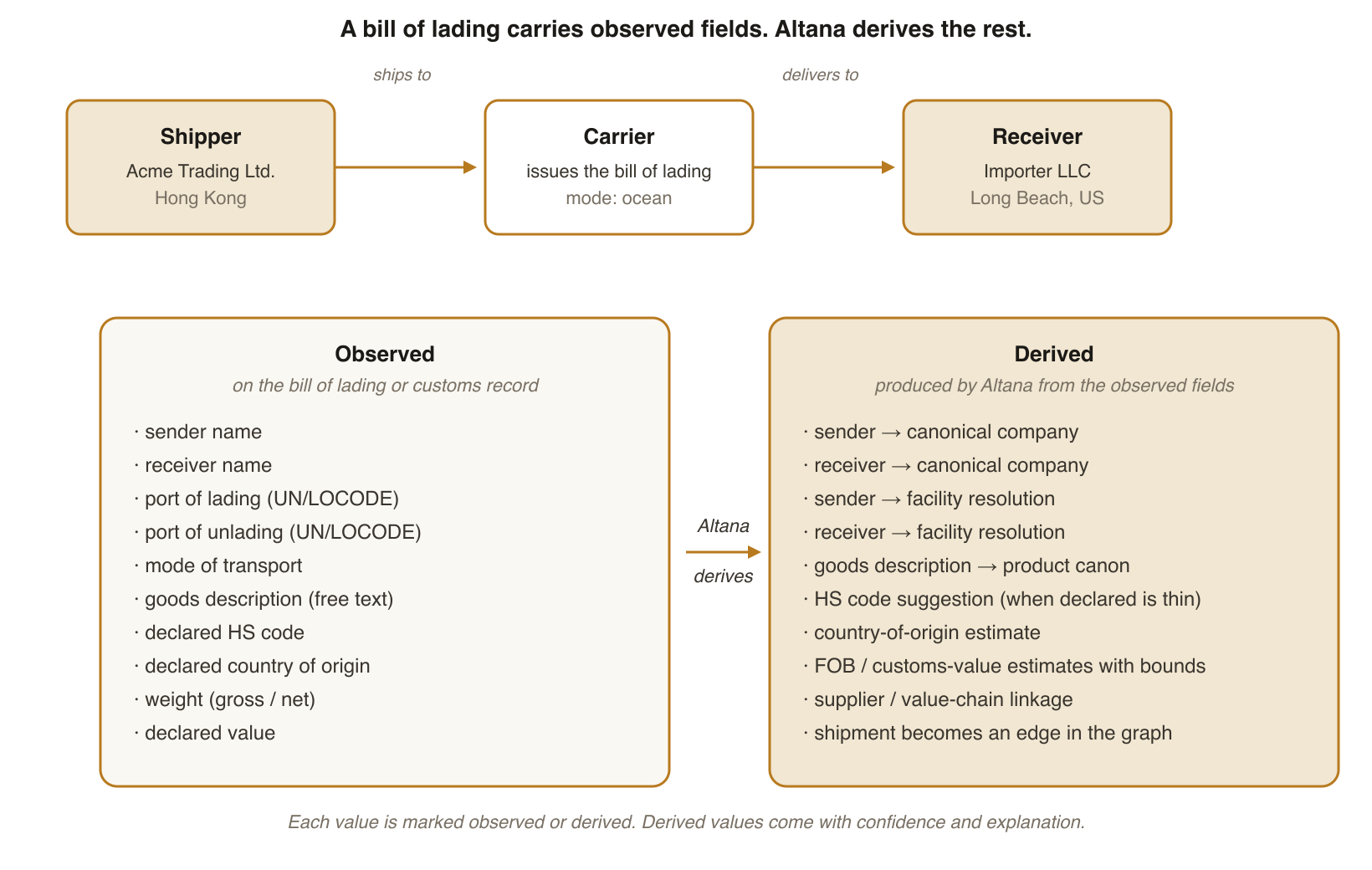
The bill of lading (BoL) is the document a carrier issues for a cargo shipment. It names the sender and receiver, the port of lading and port of unlading, the mode of transport, and a description of the goods. Altana ingests bills of lading from premier trade-data providers and from customs authorities; each one becomes a shipment record you can search, filter, and follow back to the parties involved.
A shipment is one observed movement of goods from a sender to a receiver. A transaction is the same thing viewed as a single import or export event — the atomic edge in the trade network. The two words are used interchangeably in most contexts; both describe one document, one movement, one edge.
Parties
The two named parties on a shipment record are the sender (the party shipping the goods, often listed as “shipper”) and the receiver (the party receiving them, often listed as “consignee”). On many records, the named sender or receiver is a logistics provider rather than the economic actor — a freight forwarder, a customs broker, or another intermediary handling the goods on someone else's behalf. Altana resolves both parties to canonical companies where the evidence supports it, so you can see who is actually trading even when the BoL names a courier.
Ports and mode
Every shipment carries a pair of ports. The port of lading is where the goods were loaded onto the carrier; the port of unlading is where they were discharged. Ports are usually expressed as five-character UN/LOCODE values. The mode of transport records how the goods moved — ocean, air, rail, road, or parcel. Coverage varies: most countries provide data across all modes; a few customs authorities publish maritime-only.
The goods description
The goods description is the free-text field on a shipment record that describes what was shipped. Quality varies enormously — from precise commercial descriptions (“men's woven cotton dress shirts, 100% combed cotton, 130 g/m²”) to terse generics (“apparel”) to placeholders that say almost nothing. Altana parses descriptions to extract the root product and uses them, alongside other fields, to classify shipments and resolve products. When a description is too thin to resolve, that limitation is surfaced rather than hidden.
Observed and derived
The fields above — sender name, receiver name, ports, mode, goods description, weight, declared value — are observed: they appear directly on the bill of lading or the customs record. Altana stores them as the source records say them.
Other values are derived: the canonical company a sender or receiver resolves to, the canonical product behind a description, an HS code suggestion, the upstream connections a shipment contributes to in a value chain. These are values Altana produces from the observed inputs using inference. Both observed and derived sit alongside one another on the shipment record, distinctly marked, so you always know whether you are reading a record or a derivation.
Customs records and trade documents
Customs records are declarations filed with a national customs authority when goods cross a border. They typically include parties, goods description, HS codes, declared value, country of origin, and the entry's port and date — a parallel source of shipment information to bills of lading, with different completeness and timing characteristics.
Trade documents is the broader term for the structured records that move with a cross-border shipment — bills of lading, commercial invoices, certificates of origin, customs entries. You can also upload your own trade documents into Altana to have key fields extracted; the extracted fields enter the catalog or the relevant workspace the same way other observed values do.
How you'll see this in Altana
- Company search shows shipments associated with a canonical company — both sent and received — with ports, dates, and modes filterable from the same view.
- Bills of lading and customs records appear as edges in the graph; following the edge lands you on the canonical company at the other end.
- Goods descriptions feed product matching in the catalog. Where Altana cannot match a description confidently, the matching surface tells you so.
- Customs records anchor trade compliance workspaces — classification, country of origin, USMCA, Section 232 reviews all start from the declared shipment.
- Document upload extracts BoL, invoice, and certificate-of-origin fields into the catalog and into trade compliance workspaces.
Key terms
- Bill of lading (BoL)
- The carrier-issued document for a cargo shipment. Names the sender and receiver, the port of lading and port of unlading, the mode of transport, and a description of the goods.
- Shipment
- One observed movement of goods from a sender to a receiver. Documented by a bill of lading or a customs record.
- Transaction
- A single import or export event between a sender and a receiver. The atomic edge in the trade network. Often used interchangeably with “shipment.”
- Sender / receiver
- The two named parties on a shipment record — the party shipping (often “shipper”) and the party receiving (often “consignee”). May be the economic actor or a logistics provider acting on someone else's behalf.
- Port of lading vs. port of unlading
- Port of lading is where the goods were loaded onto the carrier; port of unlading is where they were discharged. Typically expressed as UN/LOCODE values.
- Goods description
- The free-text field on a shipment record describing what was shipped. Quality varies; Altana parses descriptions to extract the root product and surfaces uncertainty where it exists.
- Mode of transport
- How the goods moved — ocean, air, rail, road, or parcel. Coverage varies by source country.
- Carrier
- The logistics company physically moving the goods. Issues the bill of lading. The named sender or receiver on the BoL may be the carrier itself when it acts as a freight forwarder for another party.
- Customs records
- Declarations filed with a national customs authority when goods cross a border. A parallel source of shipment information to bills of lading.
- Trade documents
- The structured records that move with a cross-border shipment — bills of lading, commercial invoices, certificates of origin, customs entries. Customers can upload their own to have key fields extracted.
- Observed vs. derived
- Observed fields appear directly on the source record. Derived fields are values Altana produces from those inputs — canonical-company resolution, product matching, HS suggestions, graph linkage. Both are surfaced and distinctly marked.