
The Supply Chain Graph
A continuously updated map of global trade that every Altana workflow reads from and writes back to.
The supply chain graph is Altana's living representation of global trade — a single, continuously updated map of products, the companies that make and move them, and the relationships among them. Every Altana solution — search, the catalog, value chains, trade compliance, exposure overlays — reads from and writes back to the same shared graph. When the graph improves, every workflow improves with it.
Nodes and edges
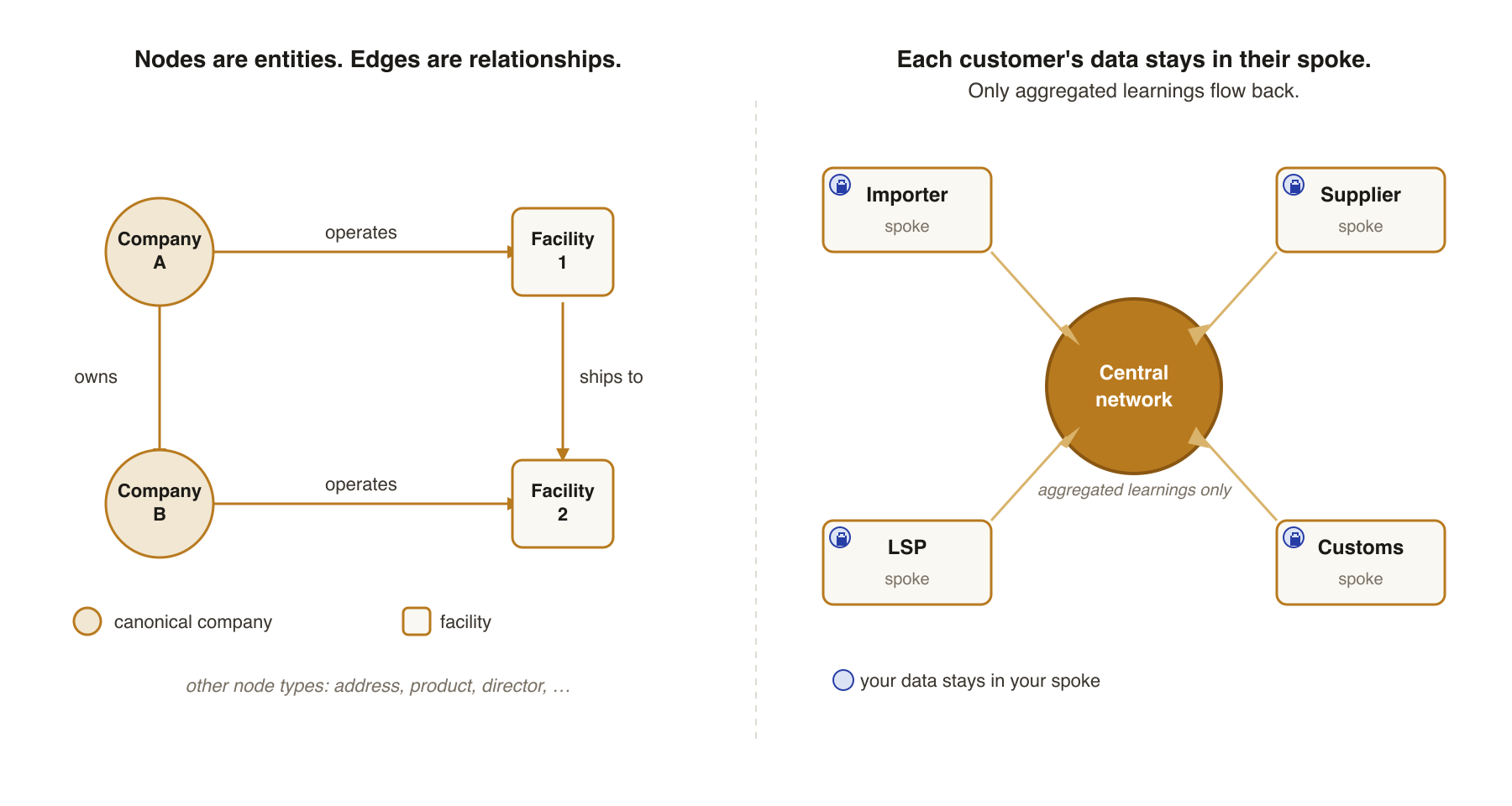
The graph is built from two primitives. A node represents a distinct entity in global trade — a canonical company, a facility, an address, a product, a director. An edge represents a relationship between two nodes — a company that ships to another company, a company that owns another, an operator that runs a facility. Nodes describe what exists; edges describe how it relates. Walked in different directions, the same graph answers different questions: who supplies whom, who owns whom, where a product was last loaded, and how a finished good traces back to its raw materials.
How the graph is built
Altana constructs the graph from four streams of input:
- Open-source public data — corporate registries, government bulletins, sanctions and watchlists, regulatory filings.
- Commercial data — corporate-ownership records and trade attributes from established providers.
- Shipment data — bills of lading and customs records from premier trade-data providers and customs authorities.
- Customer-provided information — the products, bills of materials, suppliers, and Product Passports that you and other participants share into the network.
AI then resolves entities across sources, links relationships that the evidence supports, and fills gaps where reasoning across the network can produce a defensible answer. The How Altana Infers page describes that layer in detail.
A contributory network, with privacy built in
The graph gets better as more of the network participates. Every Altana customer adds something — a catalog, a bill of materials, an exposure list, a Product Passport — and the network's accuracy and coverage improve for everyone who uses it.
Privacy is built into how that contribution flows. Altana runs a federated learning model: each customer has their own dedicated spoke where their data lives. Sensitive information stays in that spoke. Only aggregated learnings — the kinds of patterns that improve entity resolution, classification, and inference — flow back to the central network. Your data is never exposed to another customer.
Compounding network effects
This produces network effects that compound over time. Each importer brings their suppliers. Each supplier, once credentialed on the network, can serve every importer. Each government that adopts Altana creates a clearance incentive for everyone shipping into that country. The result is a shared understanding of global trade that no single participant could build alone — and that grows more accurate, more complete, and more useful for every workflow as the network grows.
How you'll see this in Altana
- Search lets you explore the graph directly — companies, facilities, the relationships between them, and the shipments that connect them.
- The catalog registers your products in the graph and reads them against everything else Altana knows.
- Value Chains are projections of the graph upstream from a finished product.
- Trade compliance workspaces use the graph to ground classification, country-of-origin, and duty determinations.
- Exposure overlays layer regulatory, ownership, and risk attributes onto the same graph.
Key terms
- Supply chain graph
- Altana's continuously updated map of global trade — a single living view of products, companies, facilities, and the relationships among them. The data foundation every Altana workflow operates on.
- Node
- A distinct entity in the graph: a canonical company, a facility, a product, a director, or another participant in global trade.
- Edge
- A relationship between two nodes — for example, that one company ships to another, owns another, or operates a facility.
- Spoke
- A customer's dedicated environment within Altana. Sensitive customer data lives in the spoke; only aggregated learnings flow back to the central network.
- Federated learning
- A networked learning approach in which each customer's data stays in their dedicated spoke while aggregated learnings flow back to the central network. How Altana improves the graph without exposing one customer's data to another.
- Network effects
- The compounding value of the graph as more of the network participates: each importer brings their suppliers, each supplier credentialed once can serve every importer, each government adoption creates clearance pull for everyone shipping into that country.
- Shared understanding
- The shared, accurate view of global trade that the graph produces — a foundation for tariffs, origin determinations, enforcement, and resilient sourcing decisions that no single participant could build alone.
Related concepts
Disclaimer: The Altana platform identifies potential sourcing and ownership relationships based on documentary evidence from the periods specified. These identifications are not definitive conclusions and may be incomplete, outdated, or subject to change. Users should independently verify critical relationship determinations.