Exposure Terminology
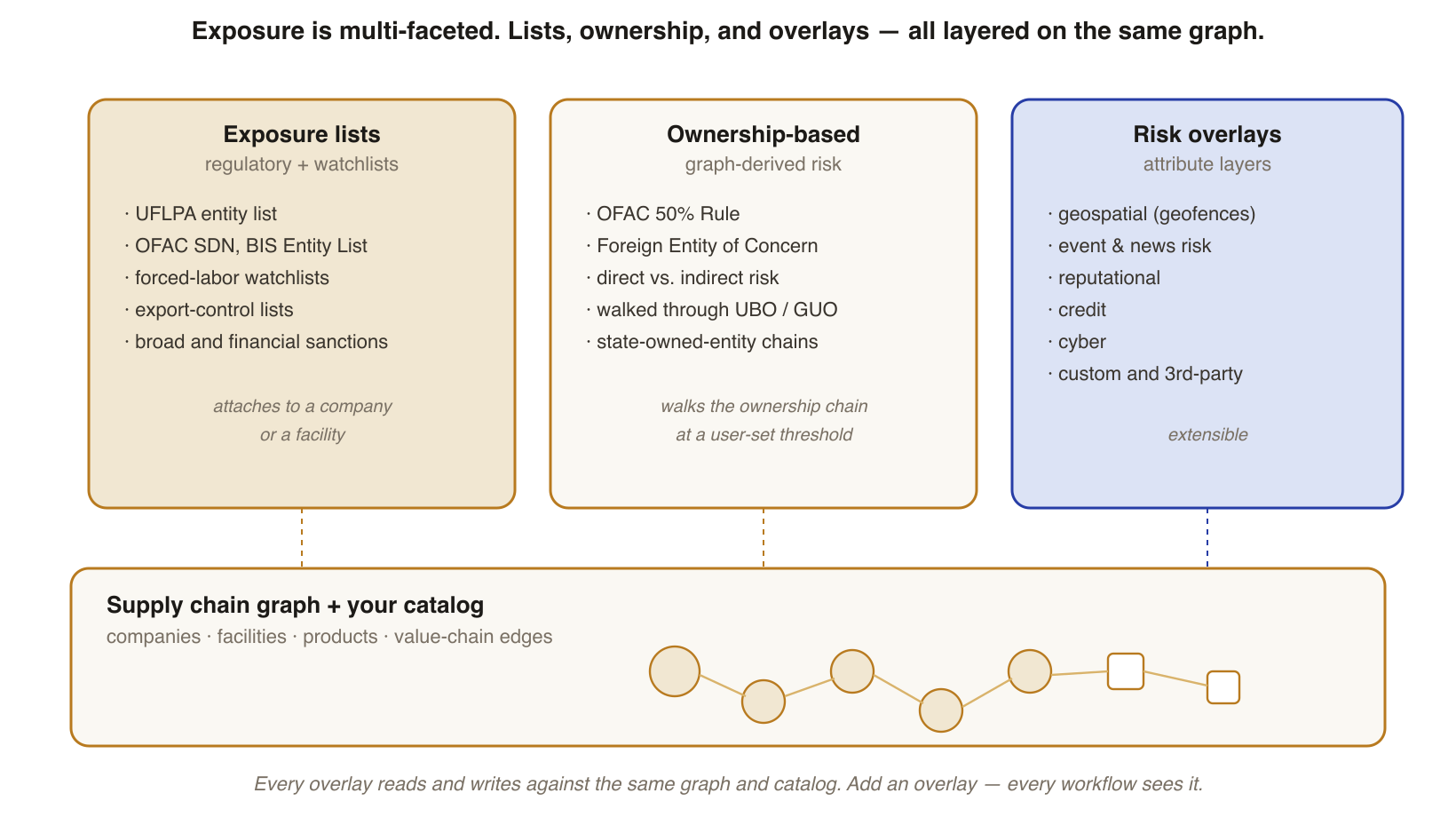
Multi-faceted risk — lists, ownership, and overlays — layered onto the same catalog and graph.
An exposure in Altana is a specific, evidence-backed connection between something in your supply chain and a flagged entity, place, or restriction. The goal is not to produce a single opaque risk score; it is to surface the concrete evidence behind a flag so your team can act on it, document it, and defend it to a regulator or auditor.
Exposure is multi-faceted. It can sit at a facility (this plant is inside a UFLPA geofence), at a company (this supplier appears on the OFAC SDN list), at the aggregate-ownership level (this supplier is 60% owned by a sanctioned parent), or at a geography (this product was country-of-origin a sanctioned country). The same supplier may carry several different kinds of exposure at once, surfaced and managed independently.
The overlay framework
Underneath the variety is a single mechanism: overlays. An overlay is an extensible set of attributes layered on top of the supply chain graph and your catalog. Altana ships standard overlays for the categories every importer needs — sanctions, forced labor, export controls, financial sanctions, foreign entities of concern. You can also configure your own overlays to integrate third-party data feeds and to encode the exposure questions your business cares about that nobody else does.
Because overlays sit on top of the graph rather than replacing it, every workflow that reads from the graph — search, value chains, trade compliance — sees exposures consistently. Adding an overlay does not require changing every downstream surface.