
Companies, Facilities & Ownership
From the brand-level company down to its filings and facilities — and back up to whoever ultimately owns it.
Most trade questions start with a counterparty. Who is this supplier? Where do they operate? Who actually owns them? The supply chain graph answers those questions by representing the businesses you do business with as canonical companies, the legal entities and facilities beneath them, and the ownership relationships you can walk up to find ultimate owners.
Canonical companies, not legal entities
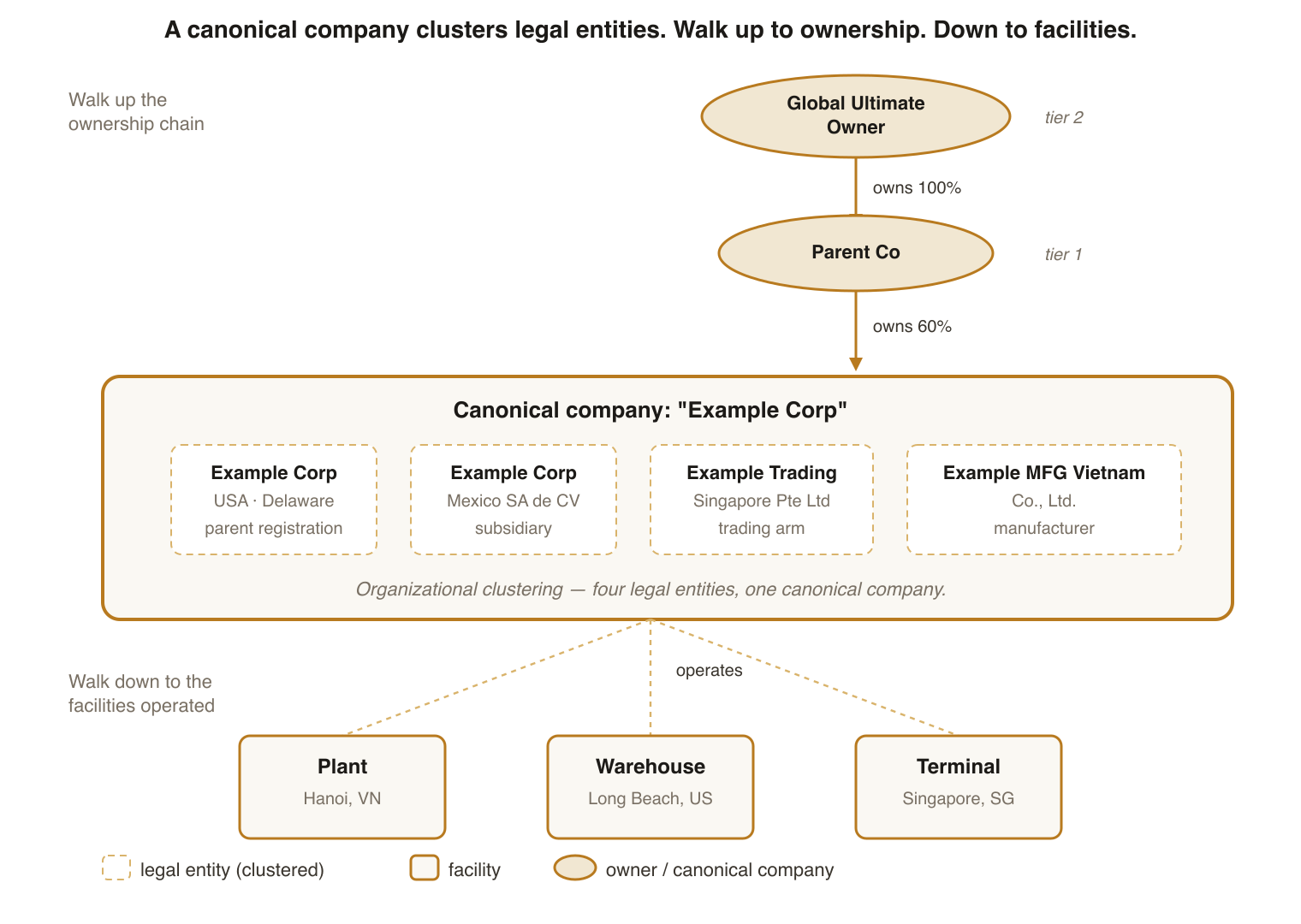
In Altana, a company is the brand-level corporate identity — the resolved representation of a business you would recognize by name — not any single legal entity, registration, or filing. A multinational like a familiar consumer-electronics maker might have hundreds of legal entities behind it: country-specific subsidiaries, franchise holders, sales operations, manufacturing arms, finance vehicles. Altana groups those legal entities, registrations, and trading names that belong to the same business into one canonical company. Activity, suppliers, ownership, and exposure all roll up to a single recognizable actor.
You also see the layer below. A legal entity is a single corporate registration — a subsidiary, a franchise, or a country-specific filing. Legal entities are the registered building blocks that compose a canonical company. Each carries its own jurisdictional identifiers, ownership stakes, and country of registration — which is distinct from where the company operates facilities or sources goods, and which is a primary input to sanctions, ownership, and trade-control screening.
Facilities
A facility is a physical place where a company operates — a plant, warehouse, port terminal, or other site that ships, receives, or produces goods. Facilities are first-class nodes in the graph and connect to the canonical companies that operate them. A single canonical company often operates many facilities, in many countries, sometimes alongside facilities operated by its subsidiaries.
Walking up the ownership chain
Above any canonical company sits its ownership chain — a directed sequence of parent and grandparent companies. Each hop in that chain is an ownership tier: tier 1 is the immediate owner, tier 2 is that owner's owner, and so on. Altana traces direct ownership up to nine tiers.
Two pieces sit at the top of the chain. The Global Ultimate Owner (GUO) is the corporate entity at the top of a company's worldwide ownership chain, determined by following control thresholds up through every parent until no further owner exceeds the threshold. The Domestic Ultimate Owner (DUO) is the corporate entity at the top of the chain within the company's own country of registration. And the Ultimate Beneficial Owner (UBO) is a natural person — an individual, not a company — who ultimately owns or controls the legal entity.
Direct and indirect ownership
Altana represents two flavors of stake. Direct ownership is a recorded equity stake one company holds directly in another, expressed as a percentage. Indirect ownership is an ownership stake where source data confirms one company sits in another's ownership structure but does not enumerate every intermediate link — Altana surfaces an aggregate indirect stake so you can still flag control even when the precise chain isn't available. Beneficial ownership rolls these up: the people or entities that ultimately benefit from, or exercise control over, a company — even when they don't appear on registration documents.
You decide how much ownership matters by setting an ownership threshold: 25% for foreign-influenced-entity rules, 50% for the OFAC and BIS 50% rules, or any value you choose. Altana lets you apply the threshold to aggregate ownership, any single owner's stake, or both.
State-owned entities
A state-owned entity (SOE) is a company owned or controlled by a government. You can filter to SOE-flagged owners to surface suppliers whose ownership chains terminate in, or pass through, a state — a common starting point for foreign-entity-of-concern, sanctions, and national-security reviews.
How you'll see this in Altana
- Company profiles in Search open against the canonical company, with the legal entities, facilities, and ownership chain laid out.
- Search and director/shareholder search walk the graph by company, by individual, or by registration.
- Ownership workspaces let you set thresholds, filter SOE owners, and quantify exposure across an entire counterparty network.
- Shipment senders and receivers resolve to canonical companies, so the same counterparty shows the same activity no matter which legal entity appears on a given bill of lading.
- The ownership-based exposure page covers how these chains feed indirect-exposure determinations.
Key terms
- Company (canonical company)
- The brand-level corporate identity in Altana — the resolved representation of a business, not any single legal entity. Activity, suppliers, ownership, and exposure roll up to it.
- Legal entity
- A single corporate registration — a subsidiary, franchise, or country-specific filing. The registered building block that composes a canonical company.
- Organizational clustering
- The process by which Altana groups related legal entities, registrations, and trading names into a single canonical company.
- Facility
- A physical place where a company operates — plant, warehouse, port terminal, or other site that ships, receives, or produces goods. A first-class node in the graph.
- Country of registration
- The jurisdiction where a legal entity is formally incorporated or filed. Distinct from where the company operates or sources, and a primary input to sanctions and trade-control screening.
- Ultimate Beneficial Owner (UBO)
- The natural person — an individual, not a company — who ultimately owns or controls a legal entity.
- Global Ultimate Owner (GUO)
- The corporate entity at the top of a company's worldwide ownership chain, determined by following control thresholds up through every parent.
- Domestic Ultimate Owner (DUO)
- The corporate entity at the top of the chain within the company's own country of registration.
- Beneficial ownership
- The people or entities that ultimately benefit from, or exercise control over, a company — even when they don't appear on registration documents.
- Parent / subsidiary
- A directed ownership relationship between two companies: the parent holds an equity stake in the subsidiary.
- Direct ownership
- A recorded equity stake one company holds directly in another, expressed as a percentage. Altana traces direct ownership up to nine tiers.
- Indirect ownership
- An ownership stake where source data confirms the relationship but doesn't enumerate every intermediate link. Altana surfaces an aggregate indirect stake.
- Ownership threshold
- The percentage of ownership at which a relationship becomes material to your question — 25% for foreign-influenced-entity rules, 50% for OFAC and BIS 50% rules, or any value you set.
- Ownership tier
- One hop in a company's ownership chain — tier 1 is the immediate owner, tier 2 is that owner's owner, and so on. Distinct from supply-chain tier.
- State-owned entity (SOE)
- A company owned or controlled by a government. Filter to SOE-flagged owners to surface state-linked counterparties.
Related concepts
Disclaimer: The Altana platform identifies potential sourcing and ownership relationships based on documentary evidence from the periods specified. These identifications are not definitive conclusions and may be incomplete, outdated, or subject to change. Users should independently verify critical relationship determinations.