
Value Chains
The multi-tier network behind a finished product — traced through the graph, shared through Product Passports.
A value chain is the end-to-end network of suppliers, manufacturers, logistics providers, and other participants that contribute to producing a finished product. Modern trade laws regulate the whole chain, not just the importer of record: rules like USMCA qualification, Section 232, UFLPA, and CBAM all require visibility into the producers behind the goods. The value chain is the unit of analysis Altana uses to deliver that visibility.
Multi-tier
Direct (tier 1) suppliers are the companies that ship goods or components directly to the importer or buyer. A multi-tier value chain extends beyond tier 1 to include the sub-tier suppliers further upstream — the makers of components, sub-components, and raw materials behind the tier 1 supplier. Most of the trade and supply-chain risk lives upstream, beyond where shipment-by-shipment visibility runs out.
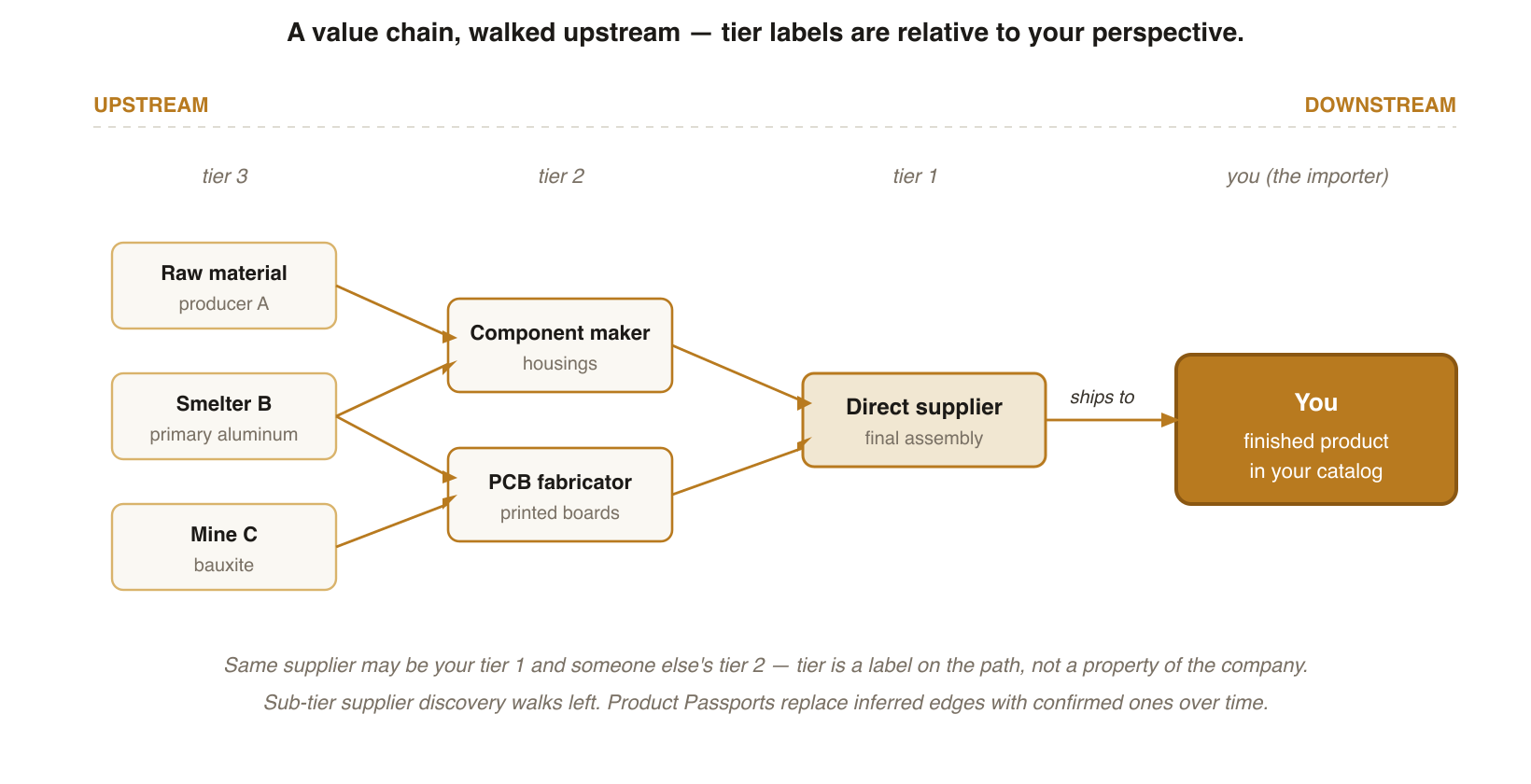
Upstream and downstream
Upstream refers to the parts of a value chain earlier in production — the suppliers, sub-suppliers, and raw-material producers that build the inputs to a product. Downstream refers to the parts closer to the end customer — the distribution channels, retailers, and end users that the finished product moves through. Trade compliance and resilience questions almost always live upstream; commercial questions about reach often live downstream.
Sub-tier supplier discovery and value chain illumination
Sub-tier supplier discovery is the work of identifying the suppliers behind your direct suppliers — the tier 2, tier 3, and deeper companies that contribute components and materials to your products. Historically this required asking your suppliers to ask their suppliers, then chasing the answers up a chain that nobody had an incentive to make transparent.
Value chain illumination is the Altana capability that uses the supply chain graph plus your catalog and supplier inputs to reveal multi-tier paths behind your products. Inputs include open-source public data, commercial sources, shipment data from premier trade-data providers and customs authorities, and customer-submitted records. Outputs are traceable value chain paths, surfaced with confidence, that you review and then confirm with your suppliers through Product Passports.
Product Passports — turning a graph projection into shared truth
A Product Passport is a shareable digital record of a product's origin story — how it is sourced, manufactured, and moved, from raw materials to finished product. The graph projection that illumination produces tells you what Altana believes; the Product Passport is the mechanism for your supplier to confirm, augment, or correct it. Once a passport is verified, you, your logistics provider, and (in the right contexts) the customs authority you ship to can all act on the same shared truth.
The full multi-tier view of a product's network, including upstream suppliers beyond the direct relationship, is sometimes called the extended value chain — particularly in government-facing copy describing what Product Passports share for pre-clearance.
How you'll see this in Altana
- Open a value chain from a catalog product to see the multi-tier supplier network behind it, with each tier labeled relative to your perspective.
- Value-chain visibility drives downstream country-of-origin, FTA qualification, and Section 232 determinations — the sub-tier producers behind a finished good are what the trade rules care about.
- Sub-tier exposure flows directly into exposure terminology — the value chain is how you find risk that doesn't show up on a tier 1 supplier alone.
- Product Passports collected from your suppliers populate the same value-chain view, replacing inferred connections with confirmed ones over time.
Key terms
- Value chain
- The end-to-end network of suppliers, manufacturers, logistics providers, and other participants that contribute to producing a finished product.
- Multi-tier value chain
- A value chain that extends beyond direct (tier 1) suppliers to include the sub-tier suppliers and producers further upstream — the makers of components, sub-components, and raw materials.
- Tier 1 supplier
- A company that ships goods or components directly to an importer or buyer. The closest ring of suppliers in a value chain.
- Tier 2 / tier 3 / tier n supplier
- Suppliers further upstream — the component makers, sub-component suppliers, and raw-material producers behind a tier 1 supplier. Most modern trade risk concentrates here.
- Tier (as a label)
- A position in a value chain relative to a chosen perspective — not a stored attribute of a company. A supplier that is your tier 1 may be your customer's tier 2.
- Upstream / downstream
- Upstream refers to the parts of a value chain earlier in production; downstream refers to the parts closer to the end customer.
- Sub-tier supplier discovery
- Identifying the suppliers behind your direct suppliers — the tier 2, tier 3, and deeper companies that contribute components and materials to your products.
- Value chain illumination
- The Altana capability that uses the supply chain graph plus your catalog and supplier inputs to reveal multi-tier paths behind a product, surfaced with confidence for review and confirmation.
- Extended value chain
- The full multi-tier view of a product's network, including upstream suppliers beyond the direct (tier 1) relationship.
- Product Passports
- A shareable digital record of a product's origin story. The mechanism for sharing and verifying multi-tier value chain information across the network — importers, suppliers, logistics providers, and customs authorities.