
How Altana Infers
AI that names what it can see, marks what it estimated, and asks before it acts on your behalf.
Altana uses AI across the product network to uncover component truth — what products are truly made of across complex, multi-tier supply chains — while keeping you in control of every decision the system makes on your behalf. Trade workflows have to hold up to regulators, auditors, and internal review, and Altana's AI is built to those standards from the start.
Observed and inferred
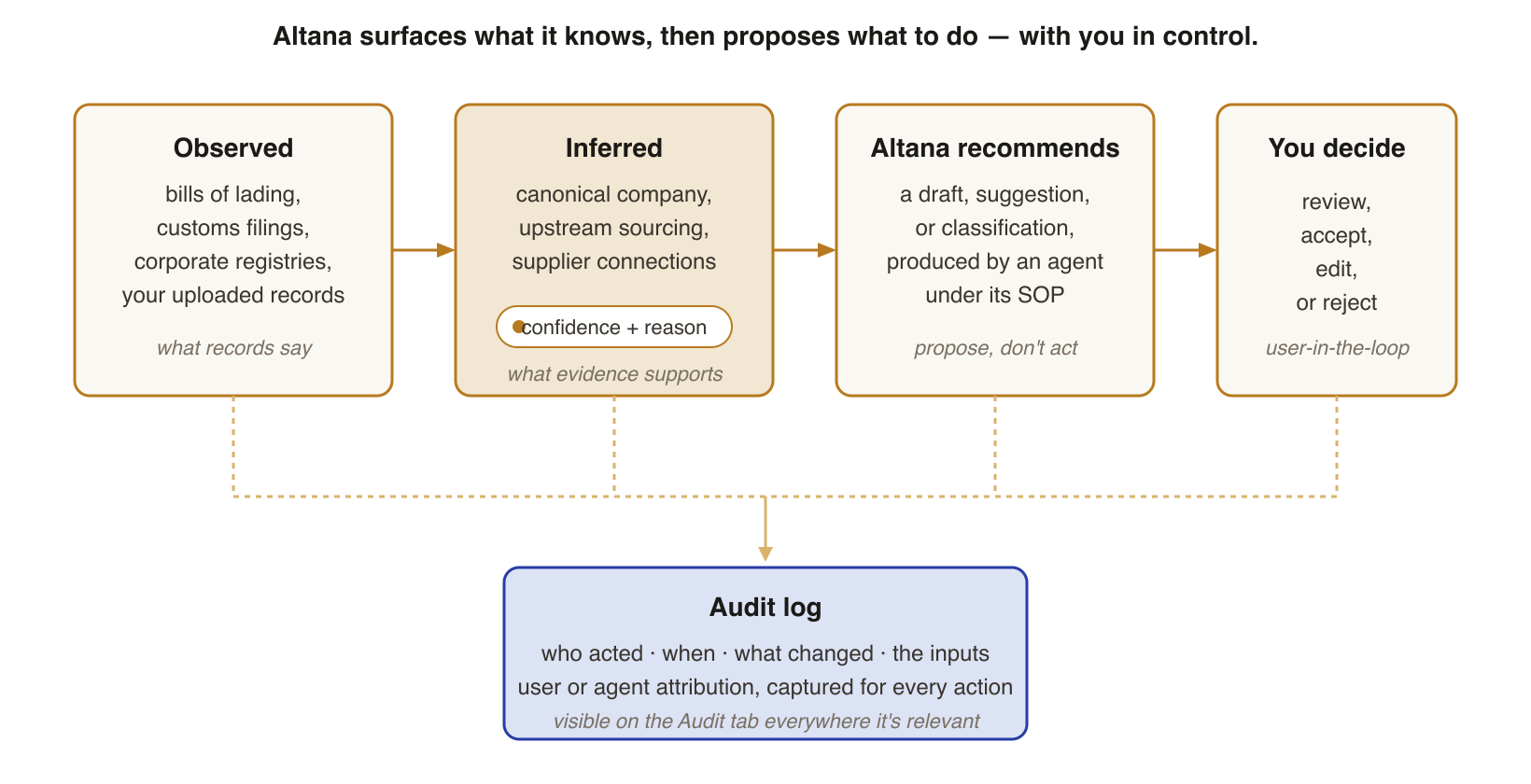
The product network is built from two kinds of information. Some details Altana observes directly in source records: a bill of lading names a sender and receiver, a customs filing carries an HS code, a corporate registry lists a director, you upload a bill of materials. Other details Altana infers by linking, enriching, and reasoning across the network: that a sender resolves to a particular canonical company, that two facilities share an operator, that a product traces upstream to a specific supplier. The product surfaces mark which is which, so you always know whether you are reading a record or a derived value.
Altana identifies connections that the evidence supports. It does not invent connections.
Confidence and explanation
Where Altana estimates a value it cannot observe directly — an upstream sourcing share, an indirect ownership stake, a likely landed-duty range — it surfaces the estimate alongside a confidence indicator and a plain-language explanation of the inputs that produced it. The estimate tells you what; the confidence and the explanation help you decide how much weight to put on it before you act.
Agents that help, with you in control
Altana also includes agents — configurable assistants that carry out portions of your workflow. An agent might classify a batch of products, draft an entry for review, screen suppliers against exposure lists, or populate a Product Passport. Each agent runs under a Standard Operating Procedure that you configure: the steps it follows, the evidence it requires, when it should ask you for input, and when it should stop. Altana ships sensible defaults, and you author and override your own.
Every agent runs with an explicit set of permissions: which tools it can call, which data it can read or write, and which actions require your approval before they take effect. By default, agents propose actions rather than take them — an agent surfaces a recommendation or a draft for you to review, accept, edit, or reject. If you want an agent to act on a specific action without prior approval, you grant that permission explicitly. Permissions can be tightened or revoked at any time.
An audit trail under everything
Every edit, classification, and decision in Altana — whether you made it or an agent acted on your behalf — is recorded in the audit log. The audit log captures who acted, when, what changed, and the inputs the action was based on. Teams use it to review work, reproduce results, satisfy regulators, and roll back changes when something needs to be unwound.
How you'll see this in Altana
- The catalog, the supply chain graph, and value-chain views mark observed values and inferred values distinctly, so you can tell at a glance whether a field is something Altana saw or something Altana derived.
- Confidence indicators sit next to inferred values in the catalog and in trade compliance workspaces. Open or hover to see the explanation behind an estimate.
- "Altana recommends" and "Ask Altana" label the recommendation and conversational surfaces wherever they appear in the product.
- Agents are configured in Settings: you author SOPs, set permissions, and review activity per agent.
- The Audit tab appears on every product profile, on every trade compliance workspace, and in Settings — the same log surfaced wherever it is relevant.
Key terms
- Component truth
- What products are truly made of across complex, multi-tier supply chains, even when the underlying records are messy or incomplete. The outcome Altana's AI is built to uncover.
- Observed vs. inferred
- Observed values come directly from source records; inferred values are produced by linking, enriching, and reasoning across the network. Altana marks the distinction on every surface and never invents a connection the evidence does not support.
- Confidence indicator
- A measure of how much weight to put on an inferred value, shown alongside a plain-language explanation of the inputs that produced it.
- Agent
- A configurable assistant that carries out a portion of your workflow under a Standard Operating Procedure and a set of permissions you define.
- Standard Operating Procedure (SOP)
- The instructions that tell an agent how to do its job: what steps to follow, what evidence to require, when to ask you, and when to stop. Altana ships defaults; you author your own.
- Agent permissions
- The tools, data, and actions an agent is allowed to use. Always explicit. You tighten or revoke them at any time.
- Suggestion-by-default
- Agents propose actions for your review rather than taking them. Direct action is opt-in: you grant the permission to act for specific actions only.
- Audit log
- The record of every change in Altana, attributed to the user or agent that made it. Surfaced as the Audit tab on product profiles, trade compliance workspaces, and Settings pages.
- Transparency and user control
- Altana exposes the inputs, reasoning, and outputs behind its AI so you can interpret a result rather than accept it on faith, and puts you in control of every decision the system makes on your behalf.
Related concepts
Disclaimer: The Altana platform identifies potential sourcing and ownership relationships based on documentary evidence from the periods specified. These identifications are not definitive conclusions and may be incomplete, outdated, or subject to change. Users should independently verify critical relationship determinations.